August 31, 2018

A Letter to the Bishops

To the Roman Catholic Bishops of the Dark Coterie, and Pope Francis, Greetings!

I, a member of the laity, a convert to the Catholic church, a doctor of the law and a teacher, have for some months...or perhaps years...remained silent, while in my acts and prayers focused on my own faults and omissions. Ever in my mind was the story related of Abba Moses, the Desert Father:
In Scetis a brother was once found guilty. They assembled the brothers, and sent a message to Moses telling him to come. But he would not come. Then the presbyter sent again saying, ‘Come, for the gathering of monks is waiting for you.’ Moses got up and went. He took with him an old basket, which he filled with sand and carried on his back. They went to meet him and said, ‘What does this mean, abba?’ He said, ‘My sins run out behind me and I do not see them and I have come here today to judge another.’ They listened to him and said no more to the brother who had sinned but forgave him.
When this latest round broke - of things reported that you have done, have covered, have ignored, have dismissed - in the grand jury statement, I could read only parts of it. And those parts were a very monument of horrors - of lives destroyed, secret meetings and symbols of slavery, cover-ups, payoffs, pederasty, quid pro quo sexual favors, profaning the Sacraments, and God Himself only knows what else. Did Steven King and Gilles de Rais draft a play on the topic, scarcely could they hope to design a more lurid and demonic affair.

We among the laity have for years carried the hope that the Church Herself would correct course; that a reformer would appear among the clergy whom would cleanse us of this festering canker. But it appears that the good among the clergy were cut short and departed early on, embittered or silenced, and those that remained had a far slimmer chance of attaining any position which would permit reform. We are aware of the good Bishops and seminaries among us. We are also aware of the bad.

And you, Dark Coterie, are among the bad. I am hesitant to say this of any priest, bishop, or cardinal - I have in me the convert's respect for the Church. But, you have thrown your lot in with the Pharisees - hypocrites, binders of burdens, creators of children of hell, blind fools, blind men, filled with extortion and rapacity, full of iniquity. How can you read Matthew 23 and not tremble if you possess even a mustard seed of faith? Fear the Lord. His Judgment is Just.

But you have accomplished worse yet. You have scandalized the Faithful, you have stunted the Church, you have thrown open the walls of the castle in which we seek shelter to the Barbarians - to those who mock and castigate. Religious freedom is under attack in the United States and the rest of the world, and you float through life in a hellish spectacle and play at games as the Church catches fire.

And those among you who covered for others? Were you compromised, that you permitted this to continue? Did you believe that you protected the Church by paying off or denigrating the victims, even as you subtly and continually undermined Her Foundations? Did you not believe that a reckoning would throw back the foul rotting cloud and reveal all? Did you Believe?

Do you Believe? Will you repent, in sackcloth and ashes? Will you show that you are sorry, instead of sorry to be caught? Will you be bound in chains? Subject yourselves to the law? Will you sacrifice your tassels and fringes and phylacteries and the higher seats at the table and your special titles, and repent, in sackcloth and ashes?

The time is fast approaching when you will be forced to repent, if you will not do so of volition. The laity already flees in scandal - perhaps your repentance, repentance in sackcloth and ashes, will begin a healing process. The hour is late. The time is short. Repent. Repent. Repent.


August 17, 2018

Bread and Circuses

In the foreword to Amusing Ourselves to Death, author and cultural critic Neil Postman set forth the possibility that Orwell was wrong - it wasn't an external tyranny that was "out to get us," in an Orwellian nightmare, but an internal tyranny of distraction and pleasure. In his own words:
What Orwell feared were those who would ban books. What Huxley feared was that there would be no reason to ban a book, for there would be no one who wanted to read one. Orwell feared those who would deprive us of information. Huxley feared those who would give us so much that we would be reduced to passivity and egoism. Orwell feared that the truth would be concealed from us. Huxley feared the truth would be drowned in a sea of irrelevance. Orwell feared we would become a captive culture. Huxley feared we would become a trivial culture, preoccupied with some equivalent of the feelies, the orgy porgy, and the centrifugal bumblepuppy. As Huxley remarked in Brave New World Revisited, the civil libertarians and rationalists who are ever on the alert to oppose tyranny "failed to take into account man's almost infinite appetite for distractions". In 1984, Huxley added, people are controlled by inflicting pain. In Brave New World, they are controlled by inflicting pleasure. In short, Orwell feared that what we hate will ruin us. Huxley feared that what we love will ruin us.
This book is about the possibility that Huxley, not Orwell, was right.
There can be no educator even remotely in touch with students who does not feel a chill upon reading this passage. It is worthwhile to know that Postman first published these words in 1985 - in 1985, when there were no iPhones, no Androids, no tablets, no internet, and barely any personal computers. The FCC noted in the New York Times in 1984 that the total number of TV stations was roughly 1,169. This sounds like a great deal, until you find out that the total number in 2017 was roughly 1,700, available networks have increased from 3 - 5 in 1984 to over 50 now, and that number of hours watched in 1984 was 7, rising as high as 9 after 2000, but falling back to 8.   This, of course, does not include stats related to computer use, video gaming, etc. For instance, from 1977 - 1993, the Apple II models sold 6 million units, worldwide. Compare that with total sales from the Playstation 4, estimated at 70 million consoles (introduced 2013), the Xbox One, estimated at 18 - 19 million consoles in 2016 (introduced 2013), and the Wii Switch, estimated at roughly 20 million consoles (introduced 2016). Of course, these numbers do not take into account legacy consoles, other manufacturers, or PC gaming systems.

Anecdotally, educators are very familiar with the ADHD-like effects of technology on their students. For instance, attention spans are very short, student no longer read significantly (and reading online does not appear to have the same impact), students often simply cut and paste portions of (what they imagine to be) articles addressing the topics of essays, and rarely seem to study. Even classes which seem to demand more than a couple hours of reading in a week are summarily dropped as "too difficult." And studies of students' habits back up these anecdotes, and reveal in many cases that students simply learn nothing in college. And, of course, there is the strange almost mandatory requirement of sexual freedom and experimentation, combined with the nearly puritanical insistence on strictures surrounding that experimentation, which treats women as de facto victims at any point in sexual activity, placing men in constant fear of punishment for lack of awareness of this victimhood.

Where am I going with this rambling, you ask?

In his Satires, the Roman poet Juvenal stated:
And what does the mob of Remus say? It follows fortune, as it always does, and rails against the condemned. That same rabble, if Nortia had smiled upon the Etruscan, if the aged Emperor had been struck down unawares, would in that very hour have conferred upon Sejanus the title of Augustus. Now that no one buys our votes, the public has long since cast off its cares; the people that once bestowed commands, consulships, legions and all else, now meddles no more and longs eagerly for just two things—Bread and Games!
Hence, the famous phrase "bread and circuses." But, witness our modern debates on mandating a basic wage for all people, regardless of will to work, to produce, to contribute, or not to do any of these things. To provide healthcare for all, on the same terms. To ensure that every person has a cell phone. To ensure that every person can purchase the things which they desire for entertainment, and to be provided with the things which ought to have been first considered. Witness the railings against student college debt (and the lack of the same concerns), when statistics indicate that $400+ per month iPhones, or the like, are a standard item among college graduates.

I think Postman was right, and that (like the late Romans), we are now in the midst of a society fueled by distraction. I do not say "amusement," as much of our own distraction is focused on rage by proxy - massive jerks of (perceived) righteous rage on social media. Our media is full of stories about people who are angry that the wealthy have much more than the poor - people who seem fueled by envy and anger, but who (one can find without much searching) have better housing, better conveniences, better care, and more available amusements and leisure than most people in recent history.

Our culture is also one which seeks to be immune from pain, or distract away from it. Witness the opoid crisis in full swing, along with the numbers of people addicted or heavily using prescription painkillers. Witness the massive push for legalization of marijuana in the United States.

Video games, sex, and addictions - all methods of distraction and avoidance of problems, pain, and (truth be known) boredom. I cannot really explain or hazard a guess as to the outcome, but I doubt that culture will be very attractive when some sort of tipping point is reached, and it all crashes down.

August 7, 2018

1st Amendment, Free Speech, Censorship, Hate Speech, Facebook

I should be working on some questions for a deposition I am taking tomorrow...I really should. But Tommy Jordan, III (who blogs here) HAD to go and post a question on Facebook (the "Post") seeking input as to what people thought of Alex Jones (this guy) being banned by various media platforms (Facebook, Apple, YouTube). Being well-connected on Facebook, there have been a wide variety of responses to Tommy's post. Most were well-intentioned, but many were also full of serious errors. I felt compelled to respond in this blog post. Thanks, Tommy.

The purpose of this blog post is to discuss some differing concepts raised by Tommy's post, and try to make some differentiation. I plan to keep things as simple as possible (who really wants to read about all the fine points of 1st Amendment debates during the Founding of the United States), while at the same time attempting to create fine enough points of distinction that the differences in the concepts can be observed.

The best place to start, as it was raised by a number of commentators on the Post, is with the 1st Amendment freedom of speech. And the place to start, if one wishes to do so with first principles in mind, is the text of that amendment, as the text pertains to freedom of speech. In relevant part, the 1st Amendment states:
Congress shall make no law ... abridging the freedom of speech, or of the press...
That's it. Of course, there are many court cases following which interpret this speech in different aspects and situations. But, what is critical, especially in the matter of Alex Jones, is to realize that the 1st Amendment restricts Congress from making laws. That's it. Now, it may have some impact on other government entities (such as state governments, local governments, etc.) due to other legal matters, but none of them change the central idea that, absent some form of government action, the 1st Amendment is not implicated in regard to speech.

So, for example, if the government makes a law requiring Facebook to remove all "hate speech" from its pages, then the government has violated the 1st Amendment, even if Facebook were willing to go along when requested. But when Facebook, in and of itself, decides to block or remove certain content on its own, no dice. Perfectly legal. Now, this is not to say that what Facebook does could implicate Civil Rights laws (so, if Facebook decided to remove all speech by Hispanics, that might implicate Civil Rights), or other laws aimed at copyright and trademark protection. However, simply in terms of blocking content Facebook doesn't like, for reasons other than Civil Rights, the 1st Amendment free speech doctrines do not apply.

Which leads me to "censorship." This term should go down with words which are "meaningless, f**king term[s]." This word gets thrown around as a derogatory phrase so often, with so many different (intended or unintended) nuances that it should be reserved for historical context only. It's like calling someone a "Nazi" - 99% of the time, the speaker has no capability to make the distinctions necessary to actually use the term correctly. Thus, the speaker is revealed as a mindless ***kwad.

Now, if we're not going to drop it, then we should make an attempt to use it more precisely. Censor, in the words of the Oxford English Dictionary, means several things. As a noun, it means:
One who exercises official or officious supervision over morals and conduct.
Or, more broadly:
An official in some countries whose duty it is to inspect all books, journals, dramatic pieces, etc., before publication, to secure that they shall contain nothing immoral, heretical, or offensive to the government. 
Note that the idea of "official" or "governmental" exists in both definitions. Relatedly, censor, as a verb, has the expected definition of "[t]o act as censor to." And therefore, censorship, as you might guess with a little thought, means:
The office or function of a censor...official supervision. [Also] control of dramatic production and films...[or]...of the press.
Now, turning to Facebook's control of content on its network, absent being forced to do so by the government, it cannot be censorship. Facebook is free to block or allow whatever content it wishes (absent, as I said before, certain specific limitations not implicated here), including anything at all which it or its audience dislikes, and it is not a censor. People who throw the word around willy-nilly, without bothering to understand the meaning of the term, ought to be forced into remedial English class taught by the ghost of Ambrose Bierce.

"Hate Speech" is another meaningless f**king term. It's a bull***t phrase, weaponized and deployed (mostly by the Left), to shut down conversation. What does it mean? Sometimes it's used to denote language which contains racist, sexist, and other *ist content. But, it's more often used to refer to speech the speaker simply doesn't like, or doesn't want to have to discuss. Claim that children who believe they are transgender often grow out of it? "Hate Speech!" Claim that people who have been charged with sexual assault should be given the benefit of "innocent until proven guilty?" "Hate speech!" And so on, and so forth.

However....it should be kept in mind that Facebook is free to deem "hate speech" any language, images, argument, discussion, meme, phrase, etc., it wants, and free to block it from its network. It doesn't matter whether it's Alex Jones or St. Patrick himself blogging about driving the serpents out of Congress - Facebook can block it.

Finally, the people on the Post who commented that it's a sad state of affairs are, likely, closest to the truth. Given that users on Facebook are capable of simply blocking or ignoring speech they don't like, and others are capable of debating speech they don't like, Facebook seems to be acting rather paternalistically. It does so, no doubt, to virtue signal how much it wants to protect people from "hate speech" and "evil" and etc. But in doing so, it helps contribute to the Balkanization of our politics and our society, by insulating people who might otherwise be open to discussion from each other. In that way, Facebook simply reinforces societal echo chambers, so that nobody need "fear" being exposed to opinions with which they disagree, or facts which might contradict their own opinions.

June 27, 2018

Women are Evil?!

There is a species of blog post / article out there which pretends via headline or introduction to discuss an issue in an evenhanded or politically neutral way, but then proceeds into the usual tribal claptrap, name calling, etc.

One such article appears today in Huffington Post, entitled "Women are Evil." Given the title itself, one might suspect that it is a bit broad. However, if simply making the claim that women can engage in evil acts, even as men do, then it would be an unremarkable and unsurprising bit of opinion, somewhat on the level of claiming that bacon and pulled pork both come from the same animal.

But, this particular article deals with the evil women in a different way than expected. The article begins with the broad statement:
The monsters are always men. They menace from the highest positions of power; they lurk in the shadows of our subconscious. At this time of reckoning ― thanks to movements like Me Too and Time’s Up ― some of our cultural monsters are being revealed. 
Again, with the exception of rhetorical flourish (surely the author is aware of true female monsters), an unsurprising statement.

The author continues to lay out her argument that women are evil as follows:
But there is a reckoning that hasn’t yet happened and that’s with women, who use their bodies and social positions as wives and mothers to mediate how we handle the monsters of our society....These intermediaries are all too often women ― white women ― of privilege, who are doing quite well under the patriarchy. It’s a neat trick ― enforcing a system that affords you an amount of privilege but also oppresses others just like you. And it’s one white women have been playing for years...It was 53 percent of white women after all who voted for Donald Trump, a president who has publicly admitted to assaulting women. Women are in positions of power in his cabinet and it is his daughter Ivanka who provided much of the cover for his policies during the campaign. Her presence, for many Trump supporters, continues to soften his most aggressive and erratic positions.
The author, Lyz Lenz, continues with examples of women (especially white women) whom she claims "cover up" for male monsters - the 53% of white women who voted for Trump, Kirstjen Nielsen who (in defending the Trump zero-tolerance policy became "another female human shield"), Ivanka Trump (who provides "cover" for Pres. Trump's policies and softens Pres. Trump's positions), and so forth.

There is an odd contradiction here. First, the argument that women are victims of male monsters and the patriarchy, in statements such as:
Patriarchy both shelters women as frail things in need of coverage and uses their bodies as human shields. It also abuses women and puts them in places where calling out abuse puts them in more danger.
Then the argument that these women are evil and intentionally "using the purity of their bodies and their roles as women and mothers to justify the menace of their actions." And that:
Ivanka Tump [sic], Melania Trump, Conway, Sanders and Nielsen are complicit. They are no innocent mothers, whose uterus provides protection for their involvement. They actively benefit and stand for a system that also demeans and destroys.
The essence of Lenz's argument is, in my own summation:
White women benefit from the male hierarchy, so they are willing to use their bodies and status to protect the evil actions of corrupt male moral monsters within the hierarchy, which abuses white women and prevents them from revealing the abuse; so their complicity in covering up the male evil destroys their innocence. 
So, Lenz appears to indicate both that white women are abused by, and victims of, the patriarchy, while simultaneously claiming that women (such as those who opposed suffrage) are not innocent and are independent moral agents.

This is a demeaning article which is viewed through the twin lenses of race relations and sex relations. In fact, the author seems like a monomaniac, so focused and biased that even women who wrote in support of men who were entirely cleared of wrongdoing (see Junot Diaz) are chided for daring to support a male even accused of sexual wrongdoing.

This article simultaneously paints women as victims, oppressors, independent thinkers, cowed into submission to powerful men, incapable of thinking independently, evil, and biased. There IS no reason, in Lenz's mind, that a woman could have supported Trump over Clinton, other than being such a victim of patriarchy that women were bowing to their husbands',  boyfriends', or fathers' demands that they vote in a certain way.

What a terrible article, devoid of any real thought, and simply mean to vilify women with whom the author disagrees, perhaps for the author to attempt reaching a moral high ground different than "I don't like Trump, and therefore, anyone white woman who supports him must be evil."

June 9, 2018

Conservative Authors - June 9, 2018

Okay, so I recently posted a query on one of my conservative / libertarian Ben Shapiro groupie sites, asking whether anyone had put together a list of conservative / libertarian / classical liberal authors to read. People had suggestions, but no list has apparently been produced. So, I will make an attempt below. This initial list will be authors only - we will get to works later. I am trying to divide these by century, with authors who lived across divides classified in the later. I am using various sources for these names, including Wikipedia, Russell Kirk's Conservative Mind, the ISI website, and various searches using the privacy-attacking know it all Google.

Really, the idea of a "conservative" seems to have come about with Edmund Burke, although I am sure there were people writing earlier who could be considered as such. I will begin the list with Burke, and will add more if I discover earlier. Also, as should be obvious, not all of these will fit within any given conception of the term "conservative," and it is difficult to

18th Century
Edmund Burke
Thomas Jefferson
Alexander Hamilton
George Washington
J.S. Mill
Thomas Paine

19th Century
Benjamin Disraeli
Frederic Bastiat
Jean-Baptiste Say
Henry David Thoreau
James F. Cooper
Alexis de Tocqueville

20th Century
George Santayana
G.K. Chesterton
C.S. Lewis
Leo Strauss
Eric Voegelin
Richard M. Weaver
Michael Oakeshott
Friedrich Hayek
Russell Kirk
Aleksandr Solzhenitsyn
Peter Viereck
Roger Scruton
Rene Girard
G.E.M. Anscombe
Milton Friedman
Robert Nisbet
Richard M. Weaver
Murray Rothbard
Ludwig von Mises
Wilhelm Ropke
Karl Popper
John Dalberg-Acton
Bertrand de Jouvenel
Michael Polanyi
Mel Bradford
Harry Jaffa
Henry Hazlitt

21st Century
Ben Shapiro
Jonah Goldberg
Walter Williams
Thomas Sowell
Antonin Scalia
Clarence Thomas
William F. Buckley, Jr.
George Nash
Robert Nozick
James V. Schall, S.J.
Wilfred McClay
R.V. Young
Patrick Deneen
Richard M. Reinsch II
Robert George
Pierre Manent
Yuval Levin
George W. Carey
George Panichas
Jude P. Dougherty
Thaddeus J. Kozinski
Peter Augustine Lawler
Bradley C.S. Watson
Ross Douthat
Christopher Dawson
Remi Brague

April 18, 2018

Hollywood Has a "Gun Problem?"

Do they call them "action movies?"

In a recent blog post on the film "A Quiet Place," critic Nicholas Barber turns his review of the film into a bit of a personal-political screed against Hollywood's "gun problem." Now, while I have not seen the film, Barber indicates that it's set in a time "just after a horde of feral alien-monsters has gobbled up most of the human race."

Sounds rather like a situation where guns might be useful. But, I digress.

He continues, in considering the family who apparently occupies most of the movie:
I won’t reveal exactly how they survive, but it would be easy to watch this film and come away with the impression that when your country/town/home is invaded, there is nothing that the authorities will be able to do about it. Your community won’t be any help, either, and there is no way you can negotiate or co-exist peacefully with the invaders. No, your only hope is to festoon your property with security cameras, learn how to hunt and prepare your own food, grow a shaggy beard (if applicable), and, most importantly, keep a shotgun handy. 
So, what he's saying is that we are living in a post-apocalyptic landscape, where nothing makes sense, the authorities are toast, the community is eaten, and people are reverting. Could be plague, zombies, nukes, you name it. Does Barber think that, but for the power of the Church, Europe would have survived the black plague? This is part of the nature of horror, especially modern, apocalyptic horror. The neighbors are fish food or have transformed or have burned up. People are themselves becoming monsters in their loneliness and dissolution of community. Look at The Road by Cormac McCarthy:
Perhaps in the world's destruction it would be possible at last to see how it was made. Oceans, mountains. The ponderous counterspectacle of things ceasing to be. The sweeping waste, hydroptic and coldly secular. The silence.
Or perhaps, if you want movies, The Book of Eli:
People had more than they needed. We had no idea what was precious and what wasn't. We threw away things people kill each other for now.
Or, if you want to go more classic, how about Lord of the Flies:
Fancy thinking the Beast was something you could hunt and kill! You knew, didn't you?' said the head. For a moment or two the forest and all the other dimly appreciated places echoed with the parody of laughter. 'You knew, didn't you? I'm part of you? Close, close, close! I'm the reason why it’s no go? Why things are what they are?” 
Barber goes on, really getting psychoanalytical with his film critique:
One of the fondest fantasies of Second Amendment obsessives is that a private citizen with a box of ammunition could fend off the US Army, should the need arise, and that fantasy is endorsed by “A Quiet Place”, in which gun-toting farmers fare better against the aliens than the entire American war machine.
IS this a "fond fantasy?" Even IF it is, he's missing the point of guns. Guns will be necessary when door to door roundups of people are in progress. It's not the US Army - it's a soldier, a neighbor, a police officer, coming to take your family.

Do you contend this is unthinkable? Do you read modern history at all? Do you know the reports of the secret police, coming in the darkness, of the disarmament of the populaces where tyranny was thereafter enforced? Or, if you do read, is it YOUR fantasy to be one of the elite who is in charge, and let others fend for themselves?
Defenders of the right to bear arms will also see flattering reflections of themselves in the film’s heroes, a photogenic white family that lives on a backwoods farm. 
Sure, unless it's Colion Noir. Or, perhaps, one of the Southern Blacks who was disarmed by Jim Crow. As noted in Slate:
The Black Code restrictions were a piece with violent attempts to disarm blacks perpetrated by local police, white state militias, and Klan-type organizations that rose during Reconstruction to wage a war of Southern “redemption.” The formal Ku Klux Klan emerged out of Tennessee in 1866. But across the South, similar organizations cropped up under names like the White Brotherhood, the Knights of the White Camellia, the Innocents, and the Knights of the Black Cross. Black disarmament was part of their common agenda.
But, I suppose, Southern Blacks were simply lost in their fantasy of equal rights to vote, equal rights to own property (and defend it). After all, it was surely untrue that, during Jim Crow, Blacks needed anything other than the (corrupt) local authorities, (inactive) federal government, (hostile) neighbors, to defend themselves. I am sure that local police departments, in that day and time, rushed out to arrest white rapists when local Blacks complained.

After chattering on in this vein, Barber closes with:
After all, it wasn’t so long ago that action heroes were never seen without a cigarette, but now even James Bond has kicked the habit. Maybe Hollywood could address its gun addiction next. When films like “A Quiet Place” tell us that a shotgun cartridge will answer our prayers and solve our problems, we shouldn’t be so quiet about it.
Well, now, Mr. Barber, that would really depend on whether your problem is an alien about to devour you, or you have a flat tire. Guns aren't the answer to everything, but in the post-apocalyptic imagination, they surely have a place when something looks to make you the next fare. In the meantime, perhaps you can stop psychoanalyzing gun owners and NRA members, and get down to actually reviewing movies.

March 5, 2018

Gun Controls That Might Work

As noted in my previous post, some of the gun-control legislation and individual / corporate actions and reactions after school or mass shootings are "feel good." Like Dick's Sporting Goods choosing not to sell any "assault-style" weapons any longer - the moves give people good and happy feelings, but do nothing to limit crime in the greater sense.

I am generally pro-Second Amendment. I believe that people have the right to defend themselves, with deadly force if necessary. I also think that most progressives who talk about "doing something," either: (1) Do not offer or cannot understand what legislation will do and not do; or (2) DO understand that legislation which makes any given firearm or type illegal will fail to accomplish its ends, and are seeking gradual steps towards seizure of all firearms.

With that said, there are some laws and actions which I think will help the violence situation. As I noted in my previous post, the majority of gun crime occurs with stolen weapons. To whit: "...further reading seems to indicate that in cases of gun crime 'in approximately 8 out of 10 cases, the perpetrator was not a lawful gun owner but rather in illegal possession of a weapon that belonged to someone else.'"

Therefore, I propose the following laws:

1. Tort or criminal liability for gun owners who fail to secure their weapons and report the theft of those weapons to police. As indicated in the article, "But more than 40 percent of those stolen guns weren't reported by the owners as stolen until after police contacted them when the gun was used in a crime." Hopefully, such a law will have the effect of making owners more aware of the need to secure their weapons, and the need to report their theft. The article also states that "[o]ne of the more concerning findings in the study was that for the majority of guns recovered (62 percent)"the place where the owner lost possession of the firearm was unknown."

2. Cracking down hard on straw purchasers. This is a problem where someone who cannot legally purchase a gun prevails on friends or family to purchase a gun on their behalf. The article notes that "One potential sign that straw purchasing is a factor in the Pittsburgh data: Forty-four percent of the gun owners who were identified in 2008 did not respond to police attempts to contact them." We have laws already against straw purchasing - the need to be enforced harshly.

3. Tort or criminal liability for parents whose in-home children are perpetrators of gun crime using weapons owned by the parents, in addition to tort or criminal liability for parents whose children post social media which threatens violence against again person, and which violence is later carried out.

4. A system of required weapons insurance policies for gun owners, which insures against use of the weapons in crime, and which will provide cushion for the above liabilities for victims.

Just some thoughts.

March 1, 2018

Tribalism and Virtue Signaling

On the heels of the most recent school shooting, a number of companies have taken steps to eliminate discounts for members of the National Rifle Association (NRA) and others have elected to stop selling certain firearms.

Wal-Mart and Dick's Sporting Goods have said that they will no longer sell firearms to anyone under the age of 21. Dick's Sporting Goods also reported that they were "immediately ending its sales of military-style semi-automatic rifles."

Delta, United Airlines, Metlife, Symantec, Simplisafe, Hertz, Enterprise, and Avis Budget announced that they had ceased offering discounts to members of the NRA. First Bank of Omaha elected to stop offering an NRA-branded VISA card. There may be others now which I have missed, and others which will do the same in the future.

The constitutionality of halting sales to anyone under the age of 21 is somewhat questionable, though that may be a question for state law. Certainly, one would have difficulty imagining that a store which stated that a person was "too old," if otherwise legally qualified to own a gun, would be on firm legal ground.

However, this aside, it is clear that what is going on here is virtue signaling to the internet mob.

Let's consider the following statistics for a moment:

1. The NRA has between 4 and 6 million members, give or take. While they say "over 5 million," rough estimates from various internet sources (such as here) seem to think it's 4 - 6, give or take.

2. The amount of gun violence committed by NRA members appears to be quite small; smaller than the general populace. For instance, it is statistically unlikely that every owner of the 270 million to 310 million guns (or more - since that is 5 years old or so), is a member of the NRA. And, it is difficult to glean how many members of the NRA commit gun crimes, or what percentage of overall gun crimes are committed by NRA members.

However, suppose we look at gun crimes committed by those who have concealed carry permits (CCP). The author estimates that there were 14.5 million CCPs as of July 26, 2016. Then, the author looks at Florida (1.4 million CCP permit holders) and Texas (1.05 million CCP holders) - both states which collect data on licenses revoked for gun crimes. The author reports:
Concealed carry permit holders are even more law-abiding than police. Between October 1, 1987 and June 30, 2015, Florida revoked 9,999 concealed handgun permits for misdemeanors or felonies. This is an annual revocation rate of 12.8 permits per 100,000. In 2013 (the last year for which data is available), 158 permit holders were convicted of a felony or misdemeanor – a conviction rate of 22.3 per 100,000.
          ... 
Among police, firearms violations occur at a rate of 16.5 per 100,000 officers. Among permit holders in Florida and Texas, the rate is only 2.4 per 100,000. That is just 1/7th of the rate for police officers. But there's no need to focus on Texas and Florida — the data are similar in other states.
Let's assume, for a moment, that 2.4 / 100,000 is a similar rate of firearms violations for the general NRA population, and that 12.8 / 100,000 is the number of annual revocations of CCPs for NRA members. Now, if my math is correct, this would mean that 144 NRA members (of 6 million) have firearms violations each year, and that 768 (of 6 million) have their CCPs revoked each year for misdemeanors or felonies. Relatedly, further reading seems to indicate that in cases of gun crime "in approximately 8 out of 10 cases, the perpetrator was not a lawful gun owner but rather in illegal possession of a weapon that belonged to someone else."

So, the question is, given the (apparently) ridiculously low rate of gun crime among NRA members (taking this data as a loose proxy), the companies ending their affiliations with NRA members can only have in mind their marketing and tribal affiliations. No step they could take in making NRA members pay more for their services will likely change deaths, shootings, or any other crime statistic. Nor will it likely reduce membership in the NRA, nor make the NRA change its stance on gun control.

The question of ceasing sales of certain firearms is a bit more complex, but (in the end) will likely result in the same outcome. Statistics of gun crimes committed each year reveal that "Handguns are used in about nine times as many murders and eight times as many nonfatal  violent crimes than rifles, shotguns, and other firearms combined." In fact, one op-ed writer has said:
The only thing unique about assault rifles is their menacing name and look, and it is these elements that make them such an appealing — if not particularly sensible — target of gun control advocates.
The same writer added:
Little wonder then that a 2004 study commissioned by the Department of Justice found that the federal ban [on assault-style rifles from 1994 to 2004] didn't lead to any decrease in gun crime or gun deaths. For starters, rifles, assault or otherwise, are rarely used in gun crime. Notwithstanding the two rifles used in San Bernardino (and a few other memorable mass killings), rifles account for only about 3% of criminal gun deaths. Gun crime in the United States, including most mass shootings, is overwhelmingly handgun crime.
So, while ceasing sale of "assault-style" rifles feels good, because the guns look like military fully-automatic weapons, it is truly only good in feeling.

As for raising the age to purchase firearms to 21 - it sounds good, but of crimes committed, how many people under the age of 21 had actually purchased the guns for themselves, and how many had stolen them from lawful owners or obtained them in other ways? While I am out of time to continue these thoughts, I hazard that more gun violence from people ages 18 - 21 is committed with stolen or gifted weapons (given the cost of purchase of weapons) than with those purchased by the criminals themselves.


February 25, 2018

Stop Believing in Science!

Ben Shapiro points out here that two public intellectuals - Neil Degrasse Tyson and Steven Pinker - have made what Shapiro argues are ridiculous Twitter statements following the school shooting in Florida.

Tyson stated:
Evidence collected over many years, obtained from many locations, indicates that the power of Prayer is insufficient to stop bullets from killing school children.— Neil deGrasse Tyson (@neiltyson) February 16, 2018
while Pinker said that the shooting and similar occurrences:
...[C]ast doubt on the idea that there is a benevolent shepherd who looks out for human welfare. What was the benevolent shepherd doing while the teenager was massacring his classmates?... If you’re counting on God to make the world a better place you are probably going to make the world a worse place because he is not listening and we saw that yesterday.
Shapiro has an excellent discussion on the problems with these statements, and I am not going to rehash them here. Also worth reading is David Bentley Hart's book "Doors of the Sea" (an abbreviated article of which is here), in which he says:
It is of course somewhat petty to care overly much about captious atheists at such a time [of a tragedy], but it is difficult not to be annoyed when a zealous skeptic, eager to be the first to deliver God His long overdue coup de grâce , begins confidently to speak as if believers have never until this moment considered the problem of evil or confronted despair or suffering or death. Perhaps we did not notice the Black Death, the Great War, the Holocaust, or every instance of famine, pestilence, flood, fire, or earthquake in the whole of the human past; perhaps every Christian who has ever had to bury a child has somehow remained insensible to the depth of his own bereavement...It would have at least been courteous, one would think, if [the atheist commentator] had made more than a perfunctory effort to ascertain what religious persons actually do believe before presuming to instruct them on what they cannot believe.
With that said, in pondering the (fairly consistent) mutterings of atheist scientists, it occurred to me that perhaps the problem religious people face is waiting for scientists, engineers, etc. to come up with solutions to the problem. After all, we do not have light shields which could be worn by all school children to prevent bullet injuries, do we? In fact, while science has been quite good at preventing and curing disease, and very good at exploration and observation, it has also been very good at identifying, developing, and selling personal and global weapons of murder, mayhem, and mass destruction, including (but not limited to): viral plague agents, incendiary devices, nuclear bombs, machine guns, flame throwers, grenades, cannon, tanks, mass starvation, and poison gas, as well as appropriating otherwise useful devices for related purposes.

The Renaissance is often posited as the bright line between the "Dark Ages" and modernity - when the tides of light started to push back the old world of religion and superstition. A useful, vague, dividing line is the year 1300 AD. Now, there had been body counts estimate quite high before that time, and quite high after. However, using Wikipedia numbers (raw, I know), which include deaths due to disease, etc., we can make a few general observations (using the high number listed):

Before 1300:

Total Deaths in War: 7,594,766 (1848 years; 549 BC - 1299 AD)

Total Years of Warring for All Wars: 2,889

Average Yearly Deaths During War: 2,629

Bloodiest War: Mongol Conquests; 40,000,000 (1206 - 1368 AD)

Bloodiest Average Deaths / Year: An Lushan Rebellion; 4,500,000 deaths per year (755-763)

After 1300:

Total Deaths in War: 59,311,510 (718 years; 1300 AD - 2018 AD)

Total Years of Warring for All Wars: 2,701

Average Yearly Deaths During War: 21,959

Bloodiest War: Taiping Rebellion; 100,000,000 (1850-1864)

Bloodiest Average Deaths / Year: WWII; 14,166,667 deaths per year (1939-1945)

So, we can see, in the much shorter period of time from 1300-2018 AD, the body count rose massively as scientists and engineers improved humanities ability to kill one another. (Note: I make no claims here as to the morality of better killing, though I am not sure scientists should be able to boast that "we've gotten so much better at curing disease and causing death..."). Perhaps this is why scientists are so concerned about global warming - science created most of the machines and methods that have, according to scientists, caused the ecological disaster in the first place.

In short, advancing the cause of science in its varied forms has proven disastrous for many members of the human race. Perhaps we should consider praying more and supporting science less, in hopes that scientists don't decide to develop some device, organism, or virus that manages to wipe us all out, for good.

February 6, 2018

Exhaustive Discussion on the released Memorandum, FISA, FISCs, Etc.

Since the opinion seems to vary widely, and I am not sure exactly what sources people are using for their information, I have decided to paste and parse the memorandum ("Memo") in an attempt to inform and (potentially) explain.

Enjoy!

The Memo begins as follows:
To: HPSCI Majority Members
From: HPSCI Majority Staff

Subject: Foreign Intelligence Surveillance Act Abuses at the Department of Justice and the Federal Bureau of Investigation
The HPSCI refers to the "House Permanent Select Committee on Intelligence," which may be located here.  The current chair is Devin Nunes (R. California), with the remaining members consisting of 12 Republicans and 9 Democrats. Pursuant to its own terms, the HPSCI:
[I]s charged with oversight of the United States Intelligence Community—which includes the intelligence and intelligence-related activities of the following seventeen elements of the U.S. Government—and the Military Intelligence Program.
Therefore, questions of abuses of power by the DoJ and the FBI would fall under the purview of this committee. The Memo continues...
Purpose...This memorandum provides Members an update on significant facts relating to the Committee's ongoing investigation into the Department of Justice (DOJ) and Federal Bureau of Investigation (FBI) and their use of the Foreign Intelligence Surveillance Act (FISA) during the 2016 presidential election cycle. Our findings, which are detailed below, 1) raise concerns with the legitimacy and legality of certain DOJ and FBI interactions with the Foreign Intelligence Surveillance Court (FISC), and 2) represent a troubling breakdown of legal processes established to protect the American people from abuses related to the PISA process.
So, okay. The Foreign Intelligence Surveillance Act, or "FISA," was sponsored by Senator Edward ("Ted") Kennedy in 1977, and signed into law in 1978. It has numerous effects, but for the purposes of the Memo, it established secret courts (secret, in this instance, meaning "not open to the public," versus "not known to exist") called "Foreign Intelligence Surveillance Courts, or "FISC"s. In order to conduct electronic surveillance on a United States citizen, a Federal officer and the attorney general must apply to a FISC to obtain a surveillance order, following certain procedures.

As part of the procedures, the Federal officer must supply to the FISC:
(3) a statement of the facts and circumstances relied upon by the applicant to justify his belief that— (A) the target of the electronic surveillance is a foreign power or an agent of a foreign power; and (B) each of the facilities or places at which the electronic surveillance is directed is being used, or is about to be used, by a foreign power or an agent of a foreign power.
I think that this is the concern of the HPSCI staff, and that which prompted the investigation and the Memo. The Memo continues...
On October 21, 2016, DOJ and FBI sought and received a FISA probable cause order (not under Title VII) authorizing electronic surveillance on Carter Page from the FISC. Page is a U.S. citizen who served as a volunteer advisor to the Trump presidential campaign. Consistent with requirements under FISA, the application had to be first certified by the Director or Deputy Director of the FBI. It then required the approval of the Attorney General, Deputy Attorney General (DAG), or the Senate-confirmed Assistant Attorney General for the National Security Division.
The FBI and DOJ obtained one initial PISA warrant targeting Carter Page and three FISA renewals from the FISC. As required by statute (50 U.S.C. §,1805(d)(l)), a FISA order on an American citizen must be renewed by the FISC every 90 days and each renewal requires a separate finding of probable cause. Then-Director James Comey signed three FISA applications in question on behalf of the FBI, and Deputy Director Andrew McCabe signed one. Then-DAG Sally Yates, then-Acting DAG Dana Boente, and DAG Rod Rosenstein each signed one or more PISA applications on behalf of DOJ.
This is outlining how the actors involved obtained the permission to surveil Carter Page. Comey was appointed by President Obama, McCabe was appointed by Comey. Yates was appointed by President Obama, Boente was appointed to positions by both President Obama and President Trump, and Rosenstein was nominated by President Trump. The Memo continues...
Due to the sensitive nature of foreign intelligence activity, PISA submissions (including renewals) before the FISC are classified. As such, the public's confidence in the integrity of the FISA process depends on the court's ability to hold the government to the highest standard particularly as it relates to surveillance of American citizens. However, the FISC's rigor in protecting the rights of Americans, which is reinforced by 90-day renewals of surveillance orders, is necessarily dependent on the government's production to the court of all material and relevant facts. This should include information potentially favorable to the target of the FISA application that is known by the government.
This is leading somewhere, but to pause for a moment, I would like to briefly note the importance that an officer before a court include information potentially favorable to the surveillance target. The most important protection against illegal searches by a government entity is the 4th Amendment to the U.S. Constitution, to wit:
The right of the people to be secure in their persons, houses, papers, and effects, against unreasonable searches and seizures, shall not be violated, and no Warrants shall issue, but upon probable cause, supported by Oath or affirmation, and particularly describing the place to be searched, and the persons or things to be seized.
This was discussed at length as applied to warrants in a case called Franks v. Delaware, 438 U.S. 154, 164-65, 98 S. Ct. 2674, 2681 (1978). Importantly, the case held:
The bulwark of Fourth Amendment protection, of course, is the Warrant Clause, requiring that, absent certain exceptions, police obtain a warrant from a neutral and disinterested magistrate before embarking upon a search.  In deciding today that, in certain circumstances, a challenge to a warrant's veracity must be permitted, we derive our ground from language of the Warrant Clause itself, which surely takes the affiant's good faith as its premise: "[No] Warrants shall issue, but upon probable cause, supported by Oath or affirmation . . . ." Judge Frankel, in United States v. Halsey, put the matter simply: "[When] the Fourth Amendment demands a factual showing sufficient to comprise 'probable cause,' the obvious assumption is that there will be a truthful showing" This does not mean "truthful" in the sense that every fact recited in the warrant affidavit is necessarily correct, for probable cause may be founded upon hearsay and upon information received from informants, as well as upon information within the affiant's own knowledge that sometimes must be garnered hastily.  But surely it is to be "truthful" in the sense that the information put forth is believed or appropriately accepted by the affiant as true. It is established law that a warrant affidavit must set forth particular facts and circumstances underlying the existence of probable cause, so as to allow the magistrate to make an independent evaluation of the matter.  If an informant's tip is the source of information, the affidavit must recite "some of the underlying circumstances from which the informant concluded" that relevant evidence might be discovered, and "some of the underlying circumstances from which the officer concluded that the informant, whose identity need not be disclosed, . . . was 'credible' or his information 'reliable.'
Keep in mind this part regarding "underlying circumstances" and credible information. Now, Franks has been interpreted and discussed many times since 1978, but importantly, it has been held not only to apply to disclosing underlying circumstances regarding sources of information, but also deliberately omitting relevant information. As the 9th Circuit Court of Appeals has held:
Under the first step of Franks, the defendant must show by a preponderance of the evidence that the affiant knowingly and intentionally, or with reckless disregard for the truth, made false or misleading statements or omissions in support of the warrant application.A negligent or innocent mistake does not warrant suppression. [A] warrant affidavit must set forth particular facts and circumstances . . . so as to allow the magistrate to make an independent evaluation of the matter. Sufficient information must be presented to the magistrate to allow that official to determine probable cause; his action cannot be a mere ratification of the bare conclusions of others. An officer presenting a search warrant application has a duty to provide, in good faith, all relevant information to the magistrate. United States v. Perkins, 850 F.3d 1109, 1116 (9th Cir. 2017).
Much of the remainder of the concern of the HPSCI investigators is related to these omissions and the potential biases displayed in actions relating to the FISA application:
1) The "dossier" compiled by Christopher Steele (Steele dossier) on behalf of the Democratic National Committee (DNC) and the Hillary Clinton campaign formed an essential part of the Carter Page FISA application. Steele was a longtime FBI source who was paid over $160,000 by the DNC and Clinton campaign, via the law firm Perkins Coie and research firm Fusion GPS, to obtain derogatory information on Donald Trump's ties to Russia.
a) Neither the initial application in October 2016, nor any of the renewals, disclose or reference the role of the DNC, Clinton campaign, or. any party/campaign in funding Steele's efforts, even though the political origins of the Steele dossier were then known to senior DOJ and FBI officials.
(b) The initial FISA application notes Steele was working for a named U.S. person, but does not name Fusion GPS and principal Glenn Simpson, who was paid by a U.S. law firm (Perkins Coie) representing the DNC ( even though it was known by DOJ at the_ time that political actorô€„… were involved with the Steele dossier). The application does not mention Steele was ultimately working on behalf of-and paid by-the DNC and Clinton campaign, or that the FBI had separately authorized payment to Steele for the same information. 
2) The Carter Page FISA application also cited extensively a September 23, 2016, Yahoo News article by Michael Isilcoff, which focuses on Page's July 2016 trip to Moscow. This article does not corroborate the Steele dossier because it is derived from information leaked by Steele himself to Yahoo News. The Page FISA application incorrectly assesses that Steele did not directly provide information to Yahoo News. Steele has admitted in British court filings that he met with Yahoo News -and several other outlets- in September 2016 at the direction of Fusion GPS. Perkins Coie was aware of Steele's initial media contacts because they hosted at least one meeting in Washington D.C. in 2016 with Steele and Fusion GPS where this matter was discussed.
a) Steele was suspended and then terminated as an FBI source for what the FBI defines as the most serious of violations-an unauthorized disclosure to the media of his relationship with the FBI in an October 30, 2016, Mother Jones article by David Com. Steele should have been terminated for his previous undisclosed contacts with Yahoo and other outlets in September-before the Page application was submitted to the FISC in October-but Steele improperly concealed from and lied to the FBI about those contacts.
b) Steele's numerous encounters with the media violated the cardinal rule of source handling-maintaining confidentiality-and demonstrated that Steele had become a less than reliable source for the FBI.
3) Before and after Steele was terminated as a source, he maintained contact with DOJ via then-Associate Deputy Attorney General Bruce Ohr, a senior DOJ official who worked closely with Deputy Attorneys General Yates and later Rosenstein. Shortly after the election, the FBI began interviewing Ohr, documenting his communications with Steele. For example, in September 2016, Steele admitted to Ohr his feelings against then candidate Trump when Steele said he "was desperate that Donald Trump not get elected and was passionate about him not being president." This clear evidence of Steele's bias was recorded by Ohr at the time and subsequently in official FBI files-but not reflected in any of the Page FISA applications.
a) During this same time period, Ohr's wife was employed by Fusion GPS to assist in the cultivation of opposition research on Trump. Ohr later provided the FBI with all of his wife's opposition research, paid for by the DNC and Clinton campaign via Fusion GPS. The Ohrs' relationship with Steele and Fusion GPS was inexplicably concealed from the FISC.
4) According to the head of the FBI's counterintelligence division, Assistant Director Bill Priestap, corroboration of the Steele dossier was in its "infancy" at the time of the initial Page PISA application. After Steele was terminated, a source validation report conducted by an independent unit within FBI assessed Steele's reporting as only minimally corroborated. Yet, in early January 2017, Director Comey briefed President-elect Trump on a summary of the Steele dossier, even though it was-according to his June 2017 testimony-"salacious and unverified." While the PISA application relied on Steele's past record of credible reporting on other unrelated matters, it ignored or concealed his anti-Trump financial and ideological motivations. Furthermore, Deputy Director McCabe testified before the Committee in December 2017 that no surveillance warrant would have been sought from the FISC without the Steele dossier information.
5) The Page FISA application also mentions information regarding fellow Trump campaign advisor George Papadopoulos, but there is no evidence of any cooperation or conspiracy between Page and Papadopoulos. The Papadopoulos information triggered the opening of an FBI counterintelligence investigation in late July 2016 by FBI agent Pete Strzok. Strzok was reassigned by the Special Counsel's Office to FBI Human Resources for improper text messages with his mistress, FBI Attorney Lisa Page (no known relation to Carter Page), where they both demonstrated a clear bias against Trump and in favor of Clinton, whom Strzok had also investigated. The Strzok/Lisa Page texts also reflect extensive discussions about the investigation, orchestrating leaks to the media, and include a meeting with Deputy Director McCabe to discuss an "insurance" policy against President Trump's election.
In essence, then, the Memo is arguing that the Steele dossier, compiled at the behest of a campaign opposed to Trump, should not have served as the basis for the obtaining of a FISA order of surveillance on Carter Page, or that it should have at least revealed the presence of information obtained and paid for by a political opponent of President Trump.

November 22, 2017

The Poor Are Being Barred From Voting...

Or are they....?

Today I spotted an interesting blog post from Robert Reich, who "served as Secretary of Labor in the Clinton administration, for which Time Magazine named him one of the ten most effective cabinet secretaries of the twentieth century." Said blog post has also been picked up by Newsweek and posted on Yahoo.

THIS blog post, entitled variously "The New Poll Tax" (blog) and "The Poor Are Being Barred From Voting. And That’s Unconstitutional..." is in serious need of Fisking.

So, let's see here. Reich states that there are several ways that the poor are being disenfranchised. Each one deserves a closer look. But before I do so, a couple comments.

I would say initially that Reich compares various laws to the poll tax, outlawed by the 24th Amendment. That Amendment states:
The right of citizens of the United States to vote in any primary or other election for President or Vice President, for electors for President or Vice President, or for Senator or Representative in Congress, shall not be denied or abridged by the United States or any State by reason of failure to pay any poll tax or other tax.
In what follows, Reich is not really arguing that there is any actual tax imposed, as far as I can see. However, the Supreme Court stated in Harper v. Virginia Board of Elections:
It is argued that a State may exact fees from citizens for many different kinds of licenses; that if it can demand from all an equal fee for a driver's license, it can demand from all an equal poll tax for voting. But we must remember that the interest of the State, when it comes to voting, is limited to the power to fix qualifications. Wealth, like race, creed, or color, is not germane to one's ability to participate intelligently in the electoral process.  Lines drawn on the basis of wealth or property, like those of race  are traditionally disfavored. To introduce wealth or payment of a fee as a measure of a voter's qualifications is to introduce a capricious or irrelevant factor.  The degree of the discrimination is irrelevant.  In this context -- that is, as a condition of obtaining a ballot -- the requirement of fee paying causes an "invidious" discrimination that runs afoul of the Equal Protection Clause.  Levy "by the poll..." is an old familiar form of taxation; and we say nothing to impair its validity so long as it is not made a condition to the exercise of the franchise. Harper v. Va. State Bd. of Elections, 383 U.S. 663, 668-69, 86 S. Ct. 1079, 1082 (1966)
Other cases interpreting the 24th Amendment have held:
It is unconstitutional to force a citizen to "either pay a poll tax or file a certificate of residence six months prior to the election." Harman v. Forssenius, 380 U.S. 528, 543, 85 S. Ct. 1177, 1186 (1965).
Outside of the 24th Amendment, the Supreme Court has also held that governments may not force people to waive constitutional rights in exchange for benefits.

With that said, there is also language in the 14th Amendment that states that the right to vote may not  be in "any way abridged" except for a voter who participates in "rebellion, or other crime." The Supreme Court interpreted this in the case of Richardson v. Ramirez to hold that this did not prevent a state from denying a convicted felon the right to vote, even if the felon had otherwise finished their sentence. 

So, while there may be no actual tax to be paid at the poll, what I suspect that Reich is doing here is arguing that these laws become a defacto way of introducing unconstitutional "wealth or property" tests for voting, and perhaps, since felons are often required to pay fines or fees as a condition of completing their punishment, they cannot vote for long periods in some states even if the right to vote is restored to felons who have otherwise finished their punishment.

In his post, Reich first argues:
In nine states, Republican legislators have enacted laws that disenfranchise anyone with outstanding legal fees or court fines. For example, in Alabama more than 100,000 people who owe money – roughly 3 percent of the state’s voting-age population – have been struck from voting rolls. 
Reich says that Alabama is one example, and that there are 8 other states that do so. He does not give an example of the laws in question, nor name the other states in which this occurs. But where are the laws that do this? I have not located any information which indicates that there are 9 states who condition voting on the payment of fines and fees outside of payment of fines and court fees for felonies committed. In these states, restoration of voting rights is specifically conditioned on repayment of fines and fees.

And, in fact, the Washington Post featured an article on November 8, 2016 entitled "These people have been barred from voting today because they’re in debt." In that article, the authors feature an interview with a woman from Alabama who cannot vote, and who says:
Forty-eight-year-old Treva Thompson won’t be voting on Election Day. It’s not that she’s turned off by the choice of candidates. It’s that she can’t. She owes around $8,000 in fines and fees, plus more than $30,000 in victim restitution related to her felony theft conviction in 2005. And she’d have to pay it all off before starting the process to have her voting rights restored. A herculean task, she explains, because she often doesn’t “even have money to get gas to go look for a job.” Speaking for individuals with criminal histories and debt, Thompson says: “We shouldn’t lose our rights as if we’re nothing.”
So, as I suspected, this is less of an issue with a poll tax and more of an issue of whether felons with debts and restitution payments can be denied the right to vote for failure to complete a felony. It's not necessary to go to "poll tax," which is very different and unconstitutional from denying felons the right to vote, which IS constitutional. There is an in-depth study here, which discusses the issue more in-depth.

However, I am still not quite sure to which laws Reich is referring. For instance, he says that:
Preventing people from voting because they owe legal fees or court fines muzzle low-income Americans at a time in our nation’s history when the rich have more political power than ever.
But also says: "These state laws are another form of voter suppression – like...bars on anyone with felony convictions from voting." This is curious, because I haven't been able to find information on fines or fees unrelated to criminal actions causing inability to vote. I would be interested in more information from Reich as to what laws he's referring to...


November 17, 2017

Jessica Chastain...

Is NOT happy that Amazons in the Justice League movie are (apparently) wearing less than they did in Wonder Woman.

Nor is, for the Yahoo! record, is Melissa Silverstein.

I really, REALLY, hate the "you hypocrite" argument; I don't normally make it, myself. But, could it be that there is, I don't know, some jealousy at the success of superhero movies, or perhaps some feeling that "When I do female nude, it's necessary to the plot, but when your Amazons dress more scantily, it's a...step backward?"

Let me see here.

I ran some searches and (with a NSFW) warning, I discovered that:

Jessica Chastain has done 3 - 4 movies in which she has appeared entirely nude, and several others with skimpy clothing. Perhaps she would say that this is artistic choice. But, really, she's done her bit for nudity on screen. And now she's concerned about Amazons?

Enough with Chastain.

Melissa Silverstein states:
Ms. Silverstein is the founder of the Women & Hollywood page / blog / movement, which
"Educates, Advocates, and Agitates for greater gender diversity in Hollywood and the global film industry." Sounds laudable. For those who are wondering, the "male gaze" vs "female gaze" thing can be found here.

Summarily, Ms. Silverstein attributes the differences in costumes between "Wonder Woman" and "Justice League" (with the latter being more skimpy) to the difference between female director Patty Jenkins, of Wonder Woman, and male director Zack Snyder, of Justice League.

She also said, based on responses to the above tweet:
So, can we take away from this that Ms. Silverstein is interested in de-sexualizing cinema? I say "BRAVO." I'm in total agreement that this should happen, from casting couch to the screen, male or female directors.

This doesn't mean, however, that one can state that women are sexualized only by male directors, but female directors can proceed with impunity, right?

Ms. Silverstein states that she "loved" the first "SMILF" episode, and is excited about another. Strangely, SMILF features at least a few scenes of nudity and sex. I don't see that Ms. Silverstein called them out for that. But then, these are female directors. Perhaps this was an oversight on her part. Let's see...
Referring to Hedy Lamarr, whom Ms. Silverstein lauds (rightly) as an inventor and actress. And yet, Lamarr also was one of the earlier progenitors of frontal nudity and portrayal of orgasms on film. But, she is excused because she was otherwise a great actress who was a brilliant inventor.

Oh, and then there's Grey's Anatomy, of which Ms. Silverstein says:
This is the same Grey's Anatomy which features (on ABC) guys fantasizing about women making out in a shower, a woman jumping up and down on a bed in lingerie, and assorted other scenes.

Ms. Silverstein's website also seems to be quite excited about television shows and movies which star or are directed by women, and feature sexualized nudity.

So, is this simply another instance of "So long as my people do it, it's okay, but if it's your people, you're 'male gazing' and 'sexualizing?'"

November 13, 2017

The Christian Idea Has...

...Not been tried and found wanting, it has been found difficult; and left untried.

Today, I am moved to write briefly about this article, entitled "I'm Catholic and Didn't Get Married in a Church For This Reason."

I fully expected that the article would reference problems with the Church's teachings on sexuality, on marriage, on children, etc. This would be de rigeur among writers on Yahoo!, or any of its linked sites (in this case, "Style Me Pretty"), and likely, among many bloggers. However, I was initially somewhat surprised to see her claim that it was all about money.

You see, the church this author initially contacted (red flag!) asked $1,200 for the use of the church. And, the author notes, "from there, our options got less and less attractive." Presumably this means that other churches charged more.

End of story, right? Money-grubbing Catholics? Seems like it. Being Catholic myself, I found this a bit shocking. Catholic churches, charging people huge sums to get married?

When reading the story, however, something became very obvious: This is a collision between the world of identity politics, "tradition," and the world of lived faith and pragmatism.

The author, a "Ximena N. Larkin" (website here, if this is the same person) reveals as follows during her brief sketch (I've fisked it for your convenience):
[W]e were both raised Catholic. Up until high school, he attended a Catholic private school. And I started every Sunday with mass and then picked a Catholic university....There was no way around it. We were engulfed in religion.
Given what follows, perhaps "[w]e had been engulfed in religion" would be more accurate.
It was the primary reason we were even considering incorporating the ritual in our wedding day. Even though during our two-year relationship, and one-year engagement we had never attended mass as a couple, we felt like it was something we had to do.
AH HAH! SO THAT'S IT. A two-year relationship and one-year engagement and never attended Mass as a couple. Yet you were both Catholic. Seems like you were awash in nostalgia and identity, not "engulfed in religion."
I was shocked to discover our first pick required a $1,200 mandatory donation for 45-minute use of the church (more than 10 times the cost of our wedding venue for the evening). 
Now wait...you already had a wedding venue reserved, and NOW you're calling around for churches? Did the desire to get married in the Church come from within you, or was it something that parents or grandparents mentioned and you decided to give it the ol' college try for them?

I am going to go out on a limb here and guess that, if you're a member of a parish, the charge to use the parish is free, or nearly so. However, if you're just calling around for a venue, they charge because it makes it less attractive to church shoppers. As I look around the internet, it seems some churches do charge for the venue due to costs inherent in a wedding and the use of the facilities. Some churches offer to waive the fee if the couple are parishioners and cannot afford it, and also offer free convalidations during weekday Mass.

And THEN, towards the end of this article, we read the following revelatory statements:
The church had played no part in our relationship. We honored and respected the traditions held by family and friends, but realized we had to make a choice between what we 'should do' and what was right for us. For us, that meant promising to honor, love and respect each other every day. A pledge requiring work from both parties and not a religious deity to do the heavy lifting for us.
[Oh, RIGHT...that's what getting married in a church means? You get GOD to do the work and rest on your laurels? BULLS**T.]
Family members still ask if one day I'll get married by the church. Being Mexican and Catholic is part of my identity so the answer is yes. One day it'll happen when we're ready, not when someone tells us to.
So, wait...was all the money stuff a serious argument? Or did you reject a Church wedding because someone told you you had to? Or because you didn't believe in the first place? Why not have a free or nearly-free convalidation done and call it good?

This is identity politics and smear in equal part and parcel. Religion when I feel like it, when it may be important to me feeling "Mexican" enough, or to show our children what it's like, or whatever.

But let's not pretend that "we couldn't afford" to get married in the Church. You didn't care about Faith at the time you got married, except as a sort of cultural crustation and a vague desire to please someone else in your life. If you simply want to say you'd fallen away from the Faith and didn't care about religion any longer, own it. You are engaged in deceiving yourself and others regarding the real reason why you didn't get married in the Church.

August 18, 2017

Tintagel - Art and Music


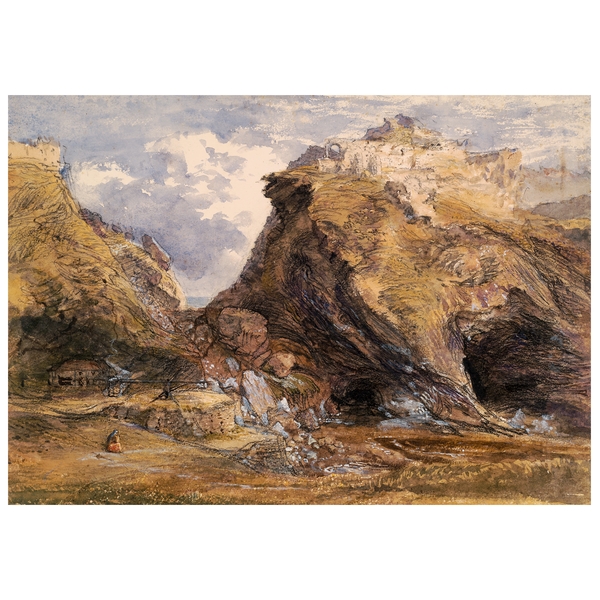
Tintagel Castle, in Cornwall, has sparked the imaginations of people since Geoffrey of Monmouth wrote (c. 1138) that King Arthur was conceived there. Abandoned in the 1600s, visitors began coming in the 19th century to see the ruins of a castle from 1233. The earlier use of the site was rediscovered (so to speak) in later archaeological digs.

Since its rediscovery, Tintagel and the rather stunning landscape of its environs, has proven to be a destination not only for the general public, but for artists of many stripes, including composers, painters, and others.

Artists I have found who painted Tintagel include:

Thomas Moran (1837 - 1926)


Samuel Palmer (1805 - 1881)


William Trost Richards (1833 - 1905)

Image result for tintagel castle trostImage result for tintagel castle trost


Image result for tintagel paintings

Thomas Rowlandson (1756 - 1827)


JMW Turner (1775 - 1851)

Image result for tintagel painting jmw turner

I am sure there are more paintings out there, and definitely thousands of photographs. 

I'd like to quote, briefly, Alfred, Lord Tennyson, from his poem "Idylls of the King," to wit:

They found a naked child upon the sands
Of dark Tintagil by the Cornish sea;
And that was Arthur; and they fostered him
Till he by miracle was approven King:
And that his grave should be a mystery
From all men, like his birth; and could he find
A woman in her womanhood as great
As he was in his manhood, then, he sang,
The twain together well might change the world.
But even in the middle of his song
He faltered, and his hand fell from the harp,
And pale he turned, and reeled, and would have fallen,
But that they stayed him up; nor would he tell
His vision; but what doubt that he foresaw
This evil work of Lancelot and the Queen?

Finally, I'd like to reference a couple compositions, namely by:

Sir Arnold Bax (1883 - 1953)


His is probably the most famous musical interpretation, but there have been others. Most of the others are more modern, vocal and tonal music. At any rate, this is a small sampling of the effect the site has had on the imaginations of artists of several walks. I hope you enjoyed it!

July 27, 2017

Trumptastic Review

Looking at the insane tweet clown show that is the presidency of Donald Trump, I wondered if I had made any predictions or statements regarding DJ Trumpy that would still hold up now. So, taking a look back at my posts of March 8, 2016, March 16, 2016, and August 7, 2016, it appears I had the following to say:

From March 8 (wherein I reported that Trump would never be president - my serious mistake):
As should be evident, you change position depending on how the question is asked and when. You make flimsy excuses ("I didn't hear the question") for bad positions, you state different things at different times, you hedge, you engage in glittering generalities, and you bluster about hand sizes and other nonsense.
Also from March 8:
We have swallowed it long enough. It is no longer a question of taking a deep breath and opposing Obama or Hilary or whomever. You have become a force to be opposed. And we will do that by refusing to vote. We think you are a charlatan - a paper tiger - a sophist - a ridiculous TV clown who opens debate answers with penis jokes.
March 16, post-nomination:
Donald Trump is a mockery of this virtue. He remembers every evil. He seems not to have grand or noble designs - instead, his every speech is flattery to the crowd. He reverses course when challenged on his own words, denying that he said them, or excusing them as an error of the moment. In fact, he seems more apt to live up to the OED obscure definitions related to his name: (1) trump - noun: "A thing of small value, a trifle; pl. goods of small value, trumpery;" and (2) trump - verb: "To deceive, cheat."
And also from March 16:
We have laughed at the idea of virtue in society, exchanging it instead for an ethics of utilitarianism. We are now on the verge of electing a man whose very nature is excess - excess in wives, in wealth, in appearance. He is the embodiment - the end, the telos - of an age dedicated to excess. His popularity cannot be denied, and I do not think it a stretch to say that his popularity is based in no small part upon his willingness to step upon and trample older ideals of virtue.

Re: Trump v. Hilary, from August 7:
This reasoning presumes, of course, that Trump is a better option than Hilary. I do not think this is proven. In fact, Trump seems equally likely to engage in all sorts of questionable, and perhaps immoral, behavior. Certainly, he has no qualms about doing that during his campaign, sounding quite insane in the process: "(Cruz’s) father was with Lee Harvey Oswald prior to Oswald being, you know, shot. I mean the whole thing is ridiculous. What is this, right, prior to his being shot? And nobody even brings it up...."
The same August 7 post:
He's a loudmouthed, buffoonish, machismo clown, with delusions of grandeur. He is completely driven by appetite - and that's quite bad. I would wager, to reference Aristotle, that he is nearly a vicious man. Does he regret making personal attacks at every turn? Does he even realize what he's doing? C.S. Lewis once noted that it would be better to live under robber barons than omnipotent moral busybodies...but what about robber barons vs. intemperate bullies? 
I think all of these are still very much apt, even more so as Trump continues his paranoid style of politics, acting as a one-man clown show.